
The French Tara Polar Station Expedition to the Arctic Ocean
The Tara Polar Station is conducting winter trials in the Bay of Bothnia northern Finland and will be anchored in the sea ice off Oulu from December 2025 to January 2026. Photo: Maéva Bardy
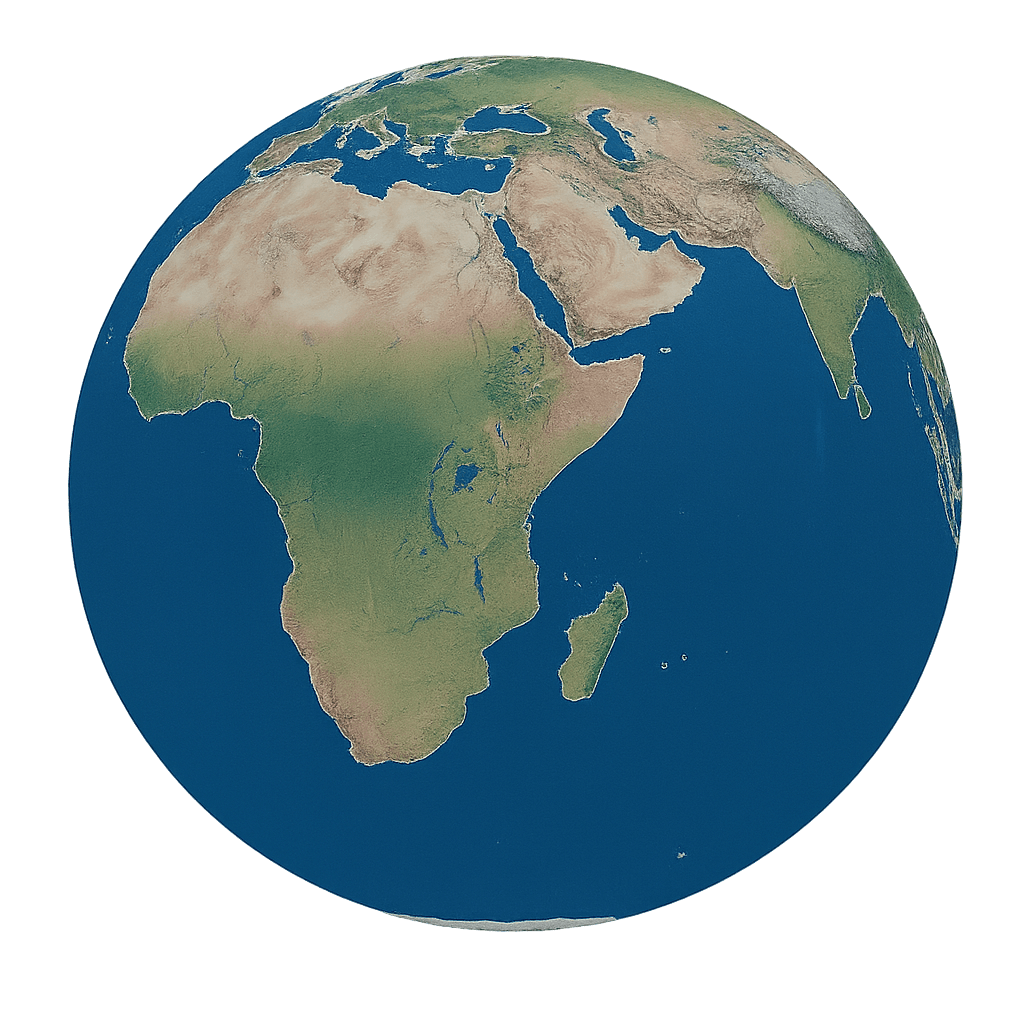
In July 2026, the French Tara Polar Station will embark on its inaugural expedition to the Arctic Ocean, one of the least observed areas on the planet, which is undergoing rapid environmental change with warming at a rate four times faster than the rest of the world.
Most scientific studies in the polar region have occurred during summer due to the harshness of the polar winter, with only three transpolar drift expeditions in all of history. Our understanding of the polar climate is incomplete because data coverage over space and time for the polar winter is limited, with key processes vital to the climate system not fully understood and investigated. Uncertainties in aerosol–cloud coupling during the polar night is a significant knowledge gap. Other gaps are the lack of polar winter measurements of ice dynamics, atmosphere-ice-ocean interactions and integration of biological, chemical, and physical processes. This means that climate models are unable to accurately forecast climate conditions resulting in diminished ability to predict and project future conditions in the Arctic.
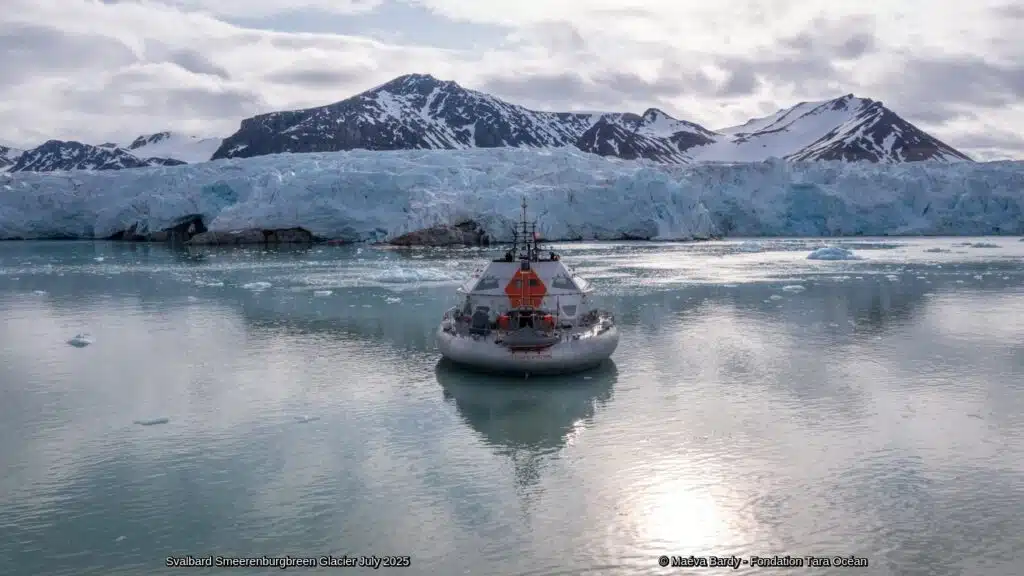
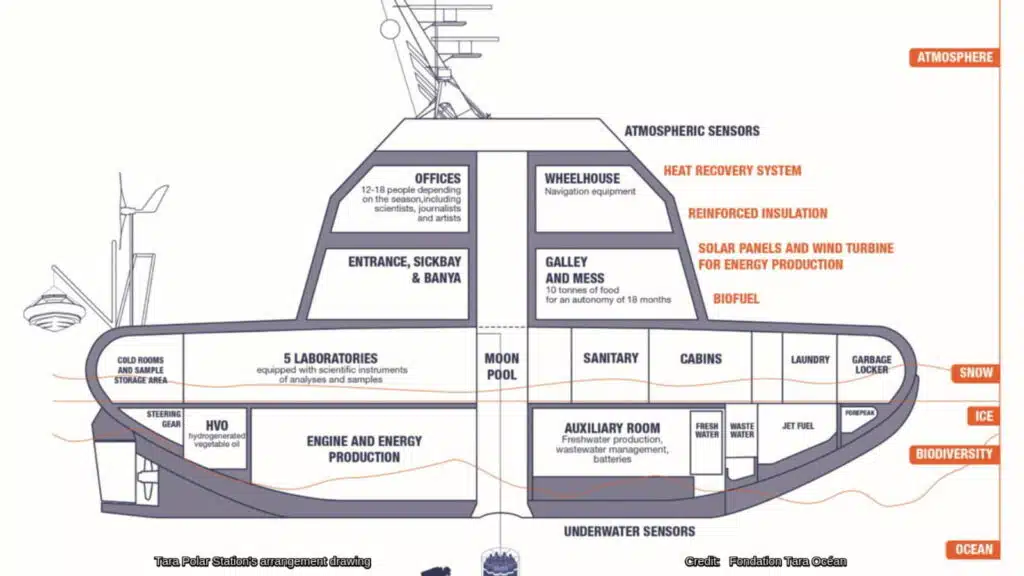
The Tara Ocean Foundation is a French public interest foundation dedicated to ocean research. Its mission – to explore the Ocean to better understand it, and to share scientific knowledge. For 20 years it has supported innovative ocean science to observe the impacts of climate change and pollution. The Tara Polar Station initiative seeks to address the polar and cryospheric science knowledge gaps by conducting a series of long-duration transpolar drifts to observe the coupled Arctic ocean–ice–atmosphere–biosphere system. However, the foundation’s Polar Program had to surmount its greatest challenge – to build a vessel that would be suitable for long term expeditions in the extreme polar environment. Significant barriers were overcome, and the construction of the Tara Polar Station began in Sept 2023, completed in April 2025. Some additional facts: 47 km of welding seams and 20 km of cables, this vessel is able to withstand temperatures to -52 degrees Celcius, the design is oval in shape to escape ice pressure and has reduced emissions by using HVO for propulsion.
I interviewed Dr. Chris Bowler, a director of research at CNRS, director of the Plant and Algal Genomics Lab at Institute of Biology of the École Normale Supérieure in Paris, Scientific Director of expedition Tara Oceans, Member of the scientific consortium of Tara and Tara Polar Station, Member of the scientific committee of Tara Ocean Foundation. Additional information provided by Romain Troublé, Directeur Général de la Fondation Tara Océan.
Why is the Tara Polar Station expedition so important?
I think the first big point is that we really don’t have enough observations about what’s happening in the Central Arctic through the seasons and through the years. When it’s dark, when it’s cold during the winter there are no scientists up there because it’s too extreme. We’re basically blind to what’s happening for most of the year to the most fragile ecosystem on Earth – warming up to four times faster than anywhere else. The second big point is that we lack observations from year to year. In the Central Arctic there have been only three trans-polar drifts in all of history – 150 years ago on the Fram, the Tara Schooner in 2006-2008, and the Stern German icebreaker in 2020-2021. This is insufficient, we need to have a time record year-after-year of the changes that are happening to understand what is the future trajectory of the Arctic? As scientists we need at least 15 years of continuous data to understand the climate trend – is it going up? is it getting colder? is it getting wetter?
What is the mission, timeline and objective of this expedition?
The mission of the Tara Polar Station is to strengthen French and international research on the Arctic environment, among the most extreme on our planet, to better understand the impact of climate change on biodiversity and the adaptive abilities of endemic species. We will be in the Arctic for the next 25 years to observe year after year what changes are taking place, essentially gathering the most important measurements that will be complementary with other measurements that we have. Our objective is to understand the interactions between the Arctic Ocean, which is liquid, and the Arctic atmosphere, which is gaseous, crucial for understanding the climate system in the Arctic. Between these two there is a tough thin membrane of ice, the Arctic ice cap, one and a half – two metres thick. This is what the Tara Polar Station will be sitting on top of as it drifts over the Arctic at approximately 10 km per day.
What is important about the Arctic Ice Cap?
This membrane of ice is teeming with microscopic life that lives inside the brine channels formed inside the ice. These different organisms have learned to adapt to the extreme winter environment where they take refuge until light conditions are more suitable for photosynthesis, stimulating the spring bloom. The sea ice algae (phytoplankton) start proliferating and growing super-fast into organic material, food for zooplankton and further up whales, seals, etc. Without phytoplankton there’s no life in the Arctic, so we need to understand the phytoplankton in the sea ice, their life cycle, their whole community of organisms, and what they’re doing through the year.
Why is this important for the climate? These organisms generate gases and aerosols active in the climate system, one of the molecules is dimethyl sulfide (DMS) emitted into the atmosphere triggering cloud formation. Life in the Arctic participates in the development of the climate system, so we want to study how sea ice biology transmits information between the ocean and atmosphere.
What are your specific plans and preparation for this Arctic expedition?
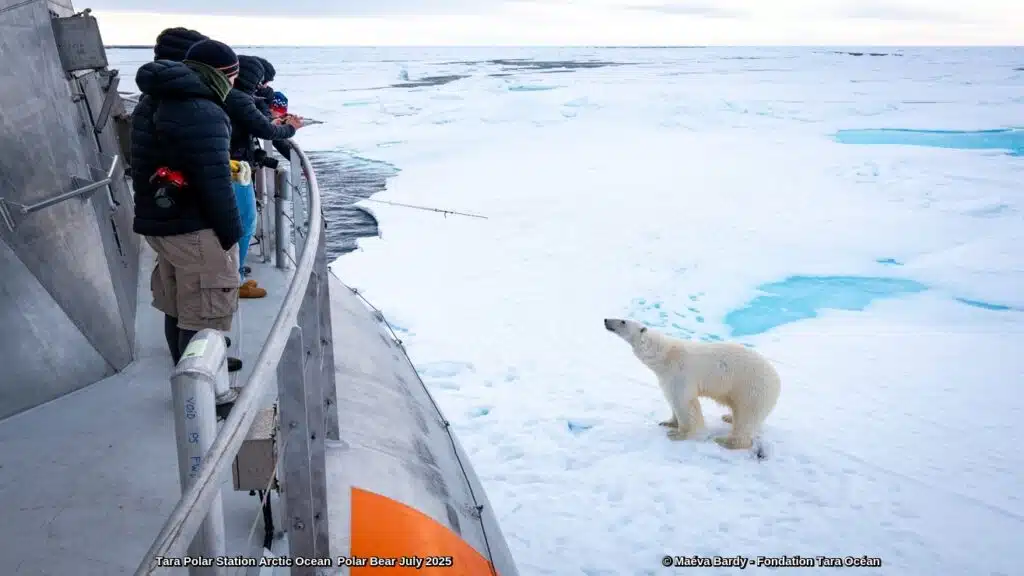
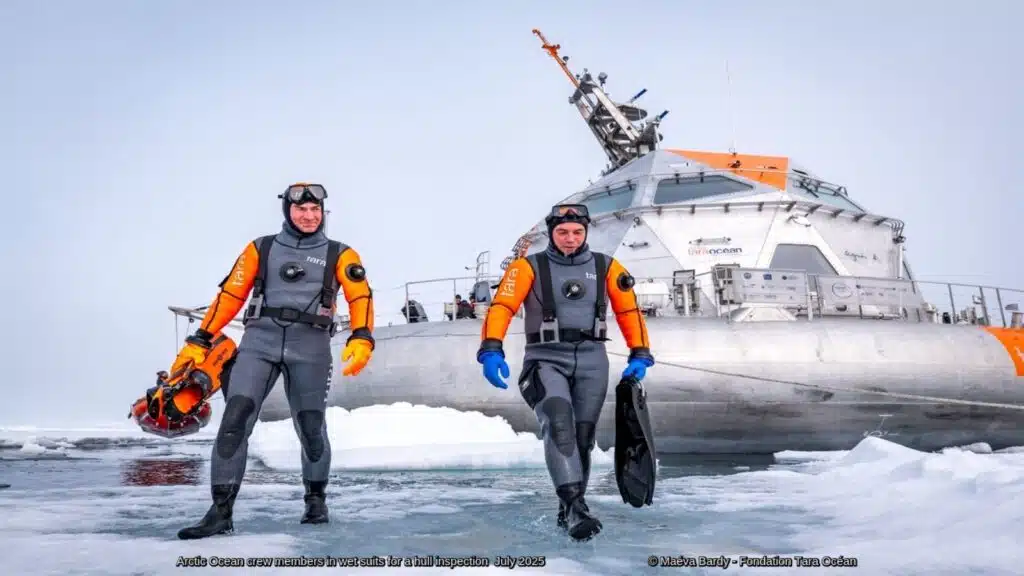
In July 2025 we carried out a four-week trial drift in the heart of the extreme Arctic sea ice environment to test her behavior, equipment, and scientific protocols.
We plan to have successive drifts with each one lasting approx. one and a half years until 2045. We will get her locked in the Arctic ice cap late August – September 2026 on the Norwegian/Russian side of the Arctic Ocean. She will move slowly in an erratic east-west transpolar drift over the North Pole and come out on the Greenland side.
The first crew of 12 (six scientists) will be onboard from August all the way through to the following spring followed by a crew rotation which will increase up to 18 people for the summer. There will be periods of darkness and isolation during the six-month winter period with temperatures ranging from -20° to -52°C. We need to be very selective about who we board similar to the principles undertaken for crew on the International Space Station. What are we looking for? We want to have an international scientific team respecting gender equality as much as possible, who understand the science of the Arctic, be good engineers able to fix things, team players, strong psychologically and physically. There will be a strict protocol day-by-day with a six-day work week with one day off. While we have strict daily protocols, we need to be reactive to interesting discoveries along the way, and be able to observe, study and understand them.
Describe the research data collection
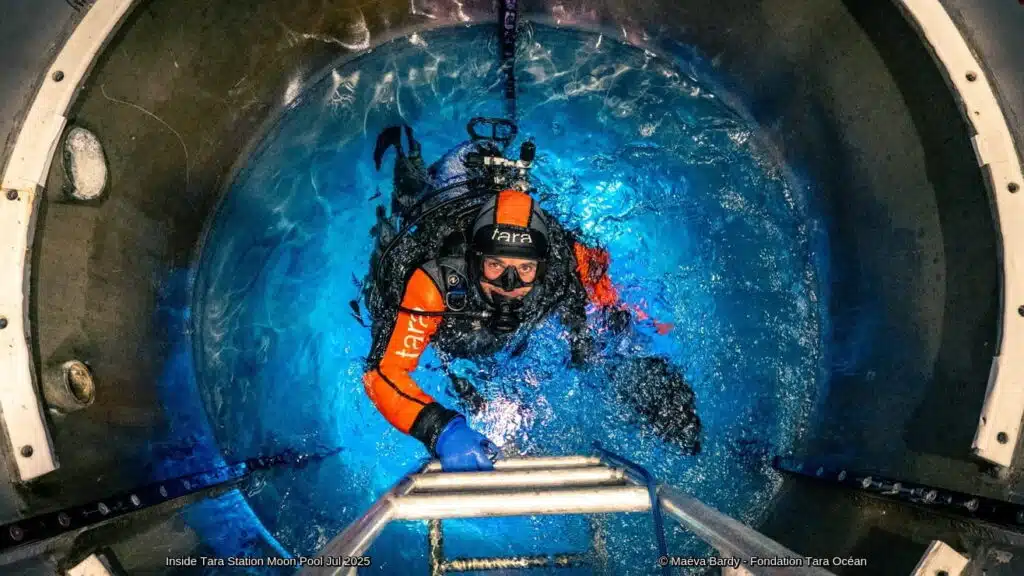
The focus of our data collection will be to gather evidence of what is happening in the sea ice and the atmosphere. Scientific analysis will take place in our mobile lab, as well as post drift. We will retrieve ice cores and send remotely operated vehicles into the water column under the sea ice as deep as 2000 meters.
For research into atmospheric conditions, we will send drones, kites, and tethered balloons about one kilometer up.
With each expedition, we will generate huge data sets through all the seasons, a beautiful time series of observations capturing things such as temperature, salinity, oxygen, nutrients which come from machines. Other measurements such as genomics to sequence DNA, microscopy, analysis of photosynthetic pigments will be done once we get back to the lab – to quantify this we will have 15 – 20 thousand samples to analyze. At the end of the mission, it will be a slow steady process to analyze the data, taking our time to do things rigorously and carefully with perhaps up to five years before we have anything really solid in terms of new discoveries. This is how science works.
Conclusion
Rapid Arctic change demands sustained large-scale observation. The Tara Polar Station transpolar drift program establishes a long-term framework for continuous measurement of the Arctic environment across seasons and decades. Through repeated drift expeditions this program will be positioned to generate useful data for Arctic climate science, and to refine the predictions of climate models in Europe by 2050. The research findings from this expedition and subsequent expeditions will help to inform societal and governmental policies for the Arctic and global ocean.
Indeed, the next 20 years are critical if we are to keep global warming within the goals set by the Paris Agreement, with climate research a key factor for this to occur.
Brenda Lovell is a freelance journalist/photographer based in Paris, France. She has done and continues to do empirical research on topics such as health, aviation, communications, Indigenous politics and oceanography. She teaches courses on a freelance basis online and in-person.
Legal Disclaimer:
EIN Presswire provides this news content "as is" without warranty of any kind. We do not accept any responsibility or liability for the accuracy, content, images, videos, licenses, completeness, legality, or reliability of the information contained in this article. If you have any complaints or copyright issues related to this article, kindly contact the author above.
